
The insect hotellocated at the intersection between urban planning and modern entomology ecological, emerges as an imperative: to reconcile our forests of asphalt with the vital cycles of nature. Currently, we are facing a crisis silent but devastating that it threatens the foundations of our food security and the stability of ecosystems. For this reason, initiatives such as project Insectopia, driven by the european alliance UGreen, are presented not only as a technical solution, but as a change of paradigm is necessary for the survival of the biodiversity in the TWENTY-first century.
This proposal of intervention not only aims to mitigate the environmental damage, but also to transform the social perception towards the insects, who are often relegated unfairly to the status of “pest” out of pure ignorance. As you well point out experts in environmental education, it is vital to reverse the negative feelings towards these animals, especially the new generations, to promote a thought of conservation of natural solid.
What is a “Hotel for Insects” and why your city needs one?
Index of the article
- 1 What is a “Hotel for Insects” and why your city needs one?
- 2 What is the project Insectopia and the alliance UGreen?
- 3 The critical importance of pollinators
- 4 Recommended materials for the construction
- 5 Step by step guide: How to create your own Insect Hotel
- 6 Stages of the project: Webinars, Competitions and the World Day of the Bee
- 7 Overcoming the “Concrete”: the Creation of micro-green areas
- 8 Education and Outreach: Schools and Institutes in Insectopia
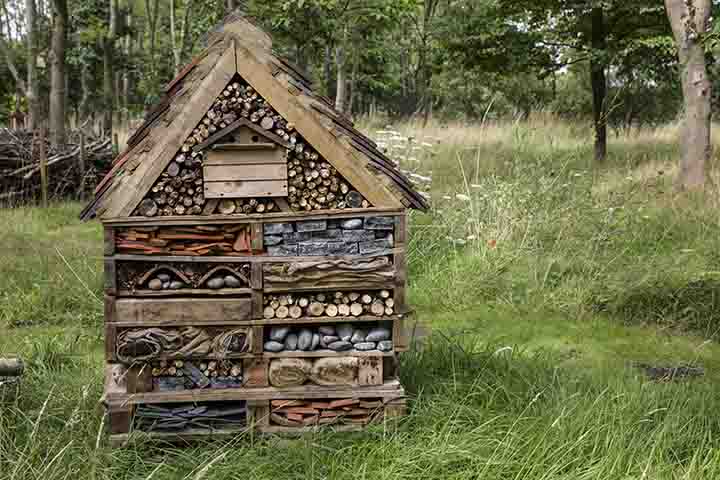
Before the loss of natural habitats due to urban expansion, the bugs are found with “biological deserts” where you have no where to nest or shelter. Here is where you come into play hotels for insects, also known as shelters entomological. So that the structures are devices, artificial designed to provide chambers and safe spaces that mimic the conditions of a natural forest or a wild field.
In the framework of the project Insectopia, promoting designs that stand out by being friendly, to be carefully tailored to the morphology and needs of nesting of local species; sustainable, through the use of natural materials or recycled materials that respect the environment; and functional, ensuring structures able to withstand the inclement weather while protecting their inhabitants from potential predators.
In this sense, the implementation of these shelters in schools and city parks allows, in addition, generate valuable pedagogical strategies. Thanks to this, students have the opportunity to identify various arthropod, close-up look of their cycles of life and conduct periodic censuses; in consequence, it is able to transform what appears initially as an object inert in a real classroom-living nature.
What is the project Insectopia and the alliance UGreen?
To understand the magnitude of such an initiative, it is essential to analyze its origin. In the first place, the project Insectopia is part of UGreen, a network of strategic collaboration that brings together nine european universities of the avant-garde. Such a coalition is not limited to theoretical research in laboratories; on the contrary, its purpose is to implement tangible improvements in the sustainability within these institutions and, similarly, to pass those benefits to the cities and civil society where they are located in their campus.
Originally, Insectopia was conceived as an internal contest to build shelters of biodiversity. However, due to the urgency of the climate crisis and the loss of habitats, it has evolved into a program of greater depth.
At present, its main objective is to raise awareness among the population about the role of the pollinators, identify the causes of their disappearance, and provide practical tools to improve their habitat in urban environments. In this way, the university ceases to be an ivory tower to become a driver of environmental change and pedagogical.
The critical importance of pollinators
The relevance of this project is best understood when we look at the global figures. According to data from the United Nations Organization for Food and Agriculture (FAO), approximately 75 % of the food crops of the world depend, at least in part, of the pollination by insects.
Therefore, three out of every four food arriving at our table exist thanks to this ecosystem service free of charge.
However, there is a common misconception to think that the pollination is work exclusive of honey bees (Apis mellifera). Although her role is vital to the ecological reality is much more complex and fascinating.
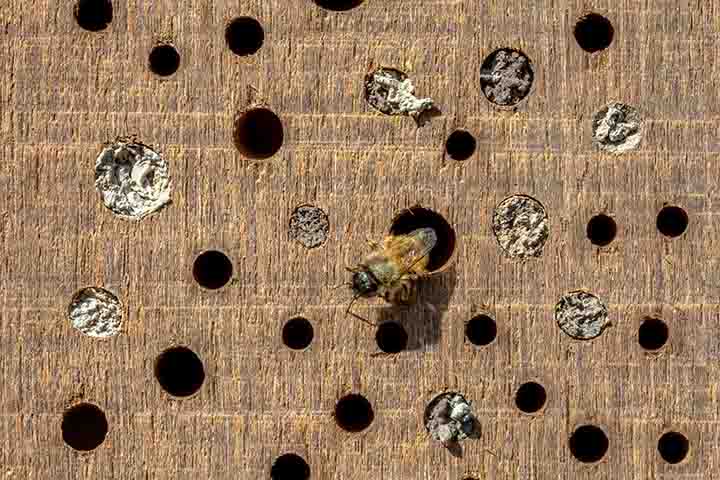
The diversity of pollinators includes:
- Wild bees and bumblebees: Many of these species are even more efficient than domestic ones for certain specific crops.
- Sírfidos and other flies: Often confused with wasps, these flies are pollinators tireless and their larvae often help control pests such as the aphid.
- Coleoptera (beetles): pollinators more ancient evolutionary history, essential for many primitive plants.
- Lepidoptera (butterflies and moths): Crucial to the diversity of wild flora and the health of the meadows.
Therefore, if we lose this diversity, not only put at risk the beauty of our landscapes, but inevitably amenazamos our main resource for the subsistence: food. In particular because the pollination guarantee the reproductive success of flowering plants, and, therefore, without this vital process, the food chain it would collapse inexorably.
Recommended materials for the construction
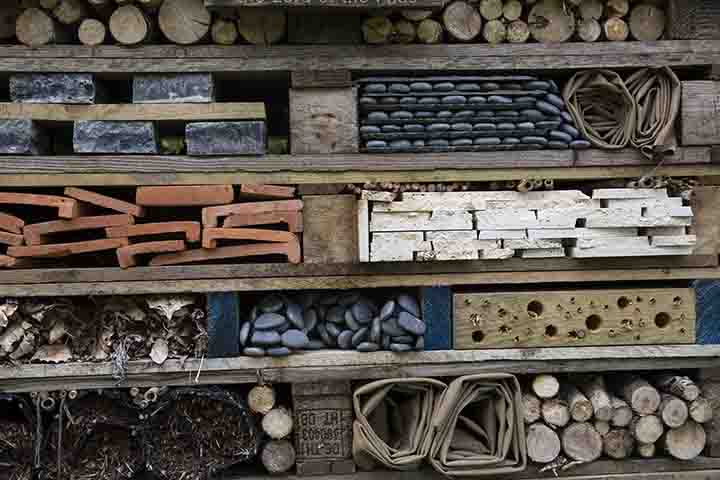
For a refuge to be effective, you must use elements to the insects to recognize and accept it as natural. Among the materials most prominent are:
- Bamboo or wood punch: Ideal for bees and solitary nesting in tunnels. It is important that the edges do not have splinters.
- Bricks with holes and clay: For species that prefer mineral materials, and thermally stable.
- Pinecones and bark: perfect Refuge for ladybugs, and lacewings, which are essential for biological control pest in urban gardens.
- Straw and dry wood: For insects looking for thermal insulation during the winter or shelter against moisture.
Step by step guide: How to create your own Insect Hotel
Build a shelter entomological is an excellent activity for the whole family or in educational centers. Here is a technical guide based on the best practices for Insectopia and experts in teaching environmental:
Planning and Design
Before hammering the first nail, identifies which species you want to attract. If you are looking for bees, solitary, you'll need to tubes of different diameters (from 2 to 10 mm). If you are looking for pest predators, prioritizes loose material such as straw or pine. In addition, the design should include a “ceiling” inclined to prevent the rain water to rot the internal materials.
Collection of Materials
Uses materials from your local environment:
- A box of wood resistant (you can reuse pallets are not chemically treated).
- Sections of cane, bamboo or hollow stalks of elderberry.
- Blocks of hard wood (oak or holm oak) to drill holes.
- Bricks, stones and pieces of tile.
- Chicken wire (optional, to prevent the birds from getting the material).
Construction of the Structure
To begin, assemble the outer frame by making sure you have at least 15-20 cm depth, as this is essential to protect the insects from air currents. Furthermore, it is crucial that you do not use paints or toxic paints; on the contrary, if you want to protect the wood safely, opt for natural oils such as linseed
- Fill and Available
First, place the heavier materials, such as bricks or wood blocks at the base to provide the necessary stability to the structure. Subsequently, it proceeds to fill remaining gaps with reeds and straw. To finish, it is critical to ensure that the filling is tight enough to prevent releases; however, it must be done with great care so as not to crush the hollow stalks that will nest"
- Strategic Location
It is important to consider that the success of your hotel directly depends on its strategic location. To do this, the structure must look towards the south or south east to receive the sunlight of the morning, as this helps the insect to “warm up their engines” thermal before the beginning of the flight.
Also, it is recommended to place it at a height of between 1 and 1.5 meters above the ground to protect it from moisture. In addition, it is essential to place it near host plants, and honey, like lavender, thyme, rosemary, daisy or dandelion; otherwise, due to the lack of food nearby, it is very likely that nobody will stay in your hotel.
Stages of the project: Webinars, Competitions and the World Day of the Bee
The deployment of Insectopia is designed to involve all sectors of society through phases and well structured. During the last year, the project has focused on the development of educational content, highlighting the performance of webinars where experts share their knowledge on the ecology and evolution of flowers and their visitors.
Subsequently, the project launched a design contest hotels for insects open to the university community. The winning projects will be presented officially on the 20th of may, coinciding with the World Day of the Bee. This landmark annual serves as a reminder that sustainability is not a distant goal, but a daily commitment. As innovation prize, the winners will participate in a week of immersion in nature in Jarandilla de la Vera, where they delve into conservation strategies active through daily field and direct observation.
Overcoming the “Concrete”: the Creation of micro-green areas
One of the biggest obstacles to urban biodiversity is the architecture based exclusively on the cement. Often, cities reduce its green areas to isolated trees surrounded by pavement. However, since the entomology ecological we know that diversity requires layers of vegetation stratified.
It should be noted that Insectopia proposes the creation of micro-green areas, tight spaces but dense that prioritize:
- Flowering shrubs and plants of small size: These plants tend to produce more flowers and easier access to the insects that the large trees.
- Diversity of Floral: it Is recommended to plant species such as la jara, el madroño, the poppy or the hawthorn, which guarantee nectar during different times of the year.
- Connectivity: Creating a network of these points green (ecological corridors) allows insects to move around the city without getting isolated fragments of habitat unfeasible.
Education and Outreach: Schools and Institutes in Insectopia
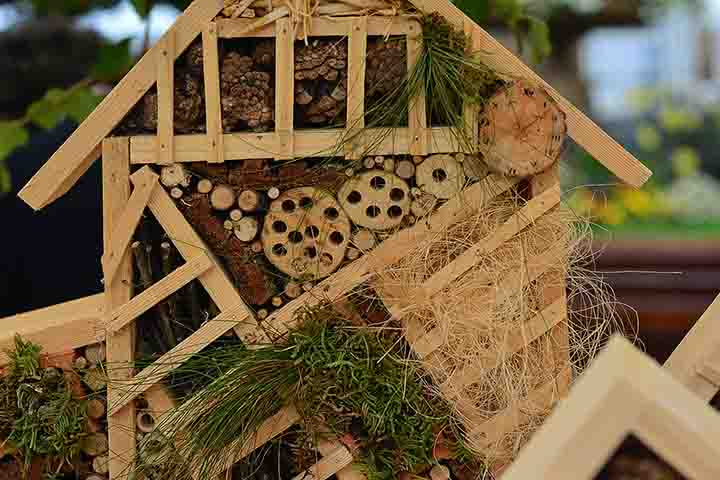
The success of Insectopia lies in its ability to transcend the academic field. In such a way that the project invites actively schools and institutes to participate by creating their own “Diaries of Field Shelter Entomological”.
In this sense, it is essential that this knowledge is communicated effectively to the educational levels of basic. In this regard, the integration of the schools in this process, are nurtured from childhood is a strong culture of respect for biodiversity. Through this approach, students learn to differentiate correctly between groups such as coleoptera, diptera and hymenoptera, understanding fully that each one plays an ecological role specific. This way, you manage to fight the irrational fear towards these animals, and replaced finally by a scientific curiosity was genuine and a real commitment to the care of the environment.
In conclusion, Insectopia represents a collective effort to give back to nature a space in our cities. Through applied science, sustainable design and environmental education, we can reverse the decline of pollinators and ensure a future where the ecological balance is the foundation of our urban well-being.
For more information on sustainable agriculture we invite you to read our article Sustainable agriculture: A Way To the Future of Food.
If you liked this article, share it on your social networks or visit us at our Youtube channel @AgrotendenciaTV. Leave us your comments.
Editorial team Agrotendencia.